
Managed services
What a managed service is
Section titled “What a managed service is”A managed service is a saved launch definition that Mewl can start, stop, restart, and reconcile with the live host runtime.
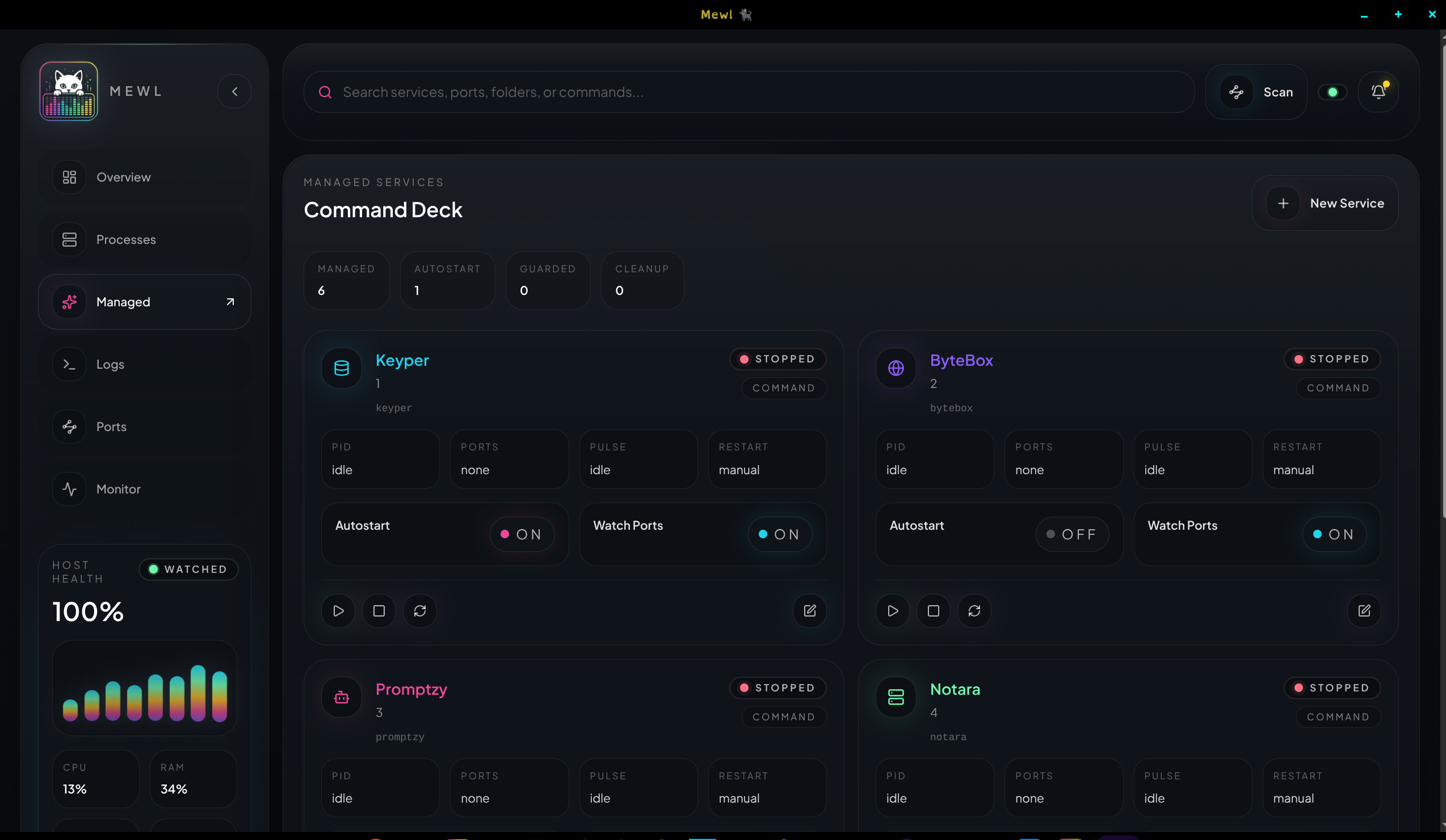
Each service can include:
- a display name
- a service mode:
command,script, ordocker - a start command
- optional stop and restart commands
- a working directory
- notes
- color and icon metadata
- restart policy settings
- watched ports and autostart flags
A good managed-service definition
Section titled “A good managed-service definition”The best managed definitions are explicit and boring in a good way. Mewl works best when the service record answers:
- what should be launched
- where it should be launched from
- how it should be stopped
- whether it should retry after failure
- which ports matter
If that information only exists in your head or in one shell history line, use the editor to make it durable.
Service modes
Section titled “Service modes”Command
Section titled “Command”Use command for standard binaries, package scripts, workers, and local daemons.
Script
Section titled “Script”Use script when the real source of truth is a launch script such as ./scripts/dev.sh or ./workers/boot.py.
Docker
Section titled “Docker”Use docker for Docker-aware start and stop flows. Mewl can derive a Docker-friendly stop command for common patterns when no explicit stop command is saved.
Restart policy
Section titled “Restart policy”Mewl supports three broad restart behaviors:
manualon-failurealways
Bounded retry counts keep automatic restarts explainable instead of opaque.
Observed to managed flow
Section titled “Observed to managed flow”If a useful process is already running, Mewl can prefill a managed draft from the observed runtime. That gives you a faster starting point without silently saving a weak definition.
Review that draft carefully before saving it. Observed runtime facts are a strong starting point, but the saved launch definition should still reflect the command you actually trust for future runs.